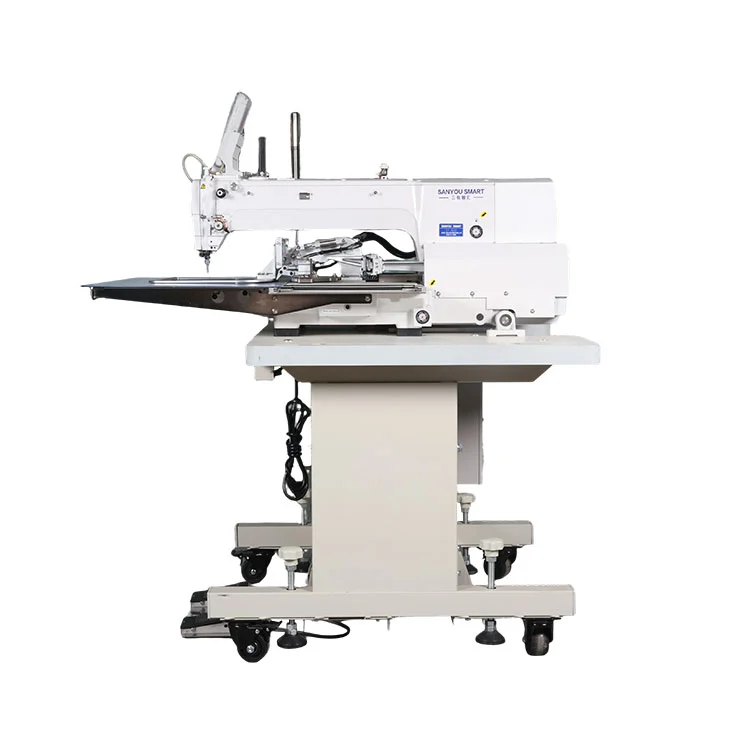
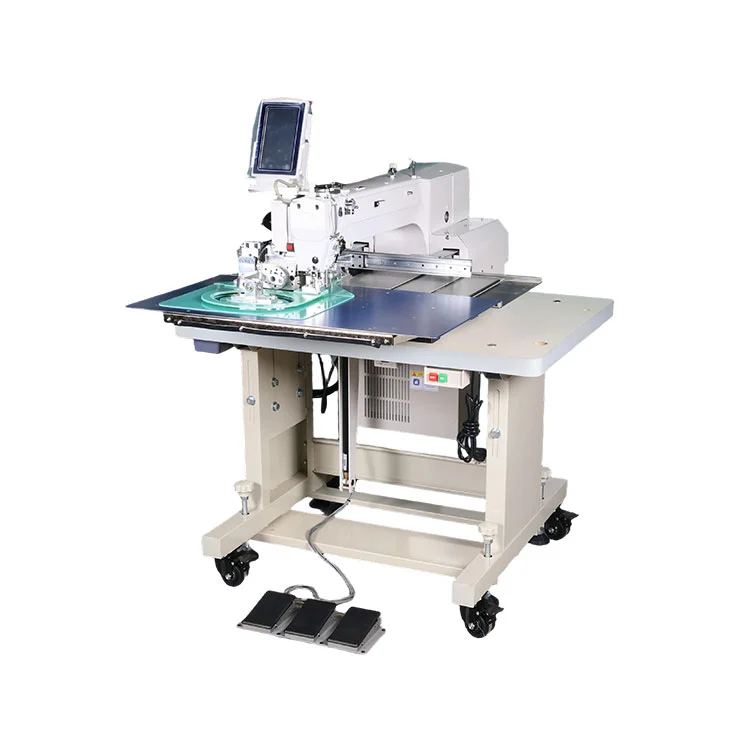
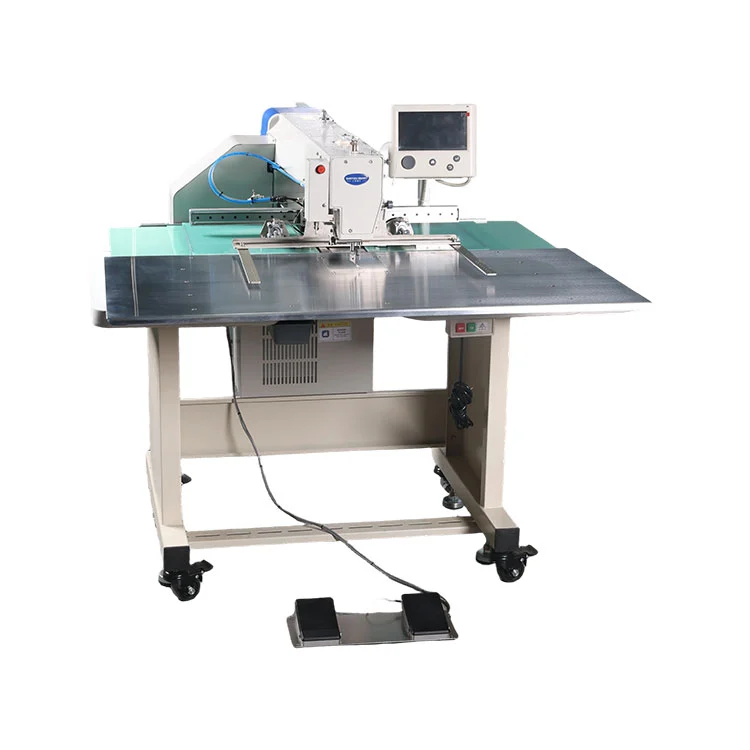
The industrial sewing sector has long grappled with a significant challenge: sewing complex curves requires a high level of skill—typically acquired only through years of experience—making it difficult for less-seasoned workers to perform the tasks effectively. Furthermore, manual operation often leads to inconsistencies, resulting in high rework rates that negatively impact both production efficiency and cost control. In this context, computerized pattern sewing machines—a form of intelligent sewing equipment—have emerged as a key solution to the dilemmas faced by traditional manufacturing.
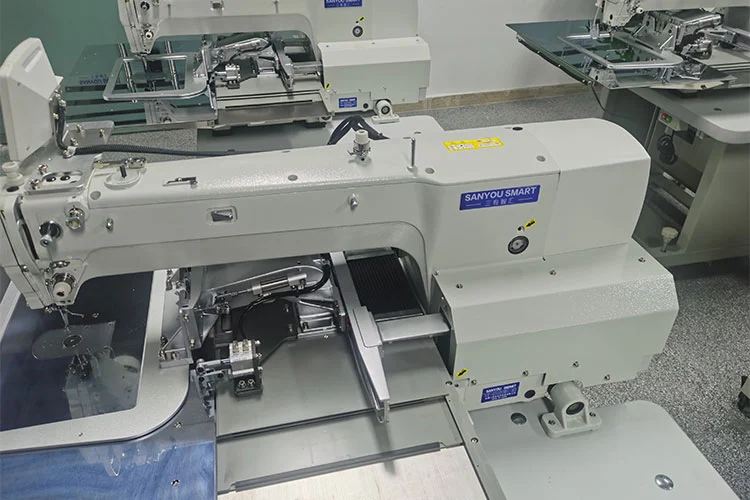
Computerized pattern sewing machines—also known as programmable electronic pattern sewing machines or CNC pattern sewing machines—are, in essence, industrial-grade, intelligent, numerically controlled sewing solutions. By using pre-set programs to control the sewing path, these machines automate the creation of complex stitch patterns. They are widely used in manufacturing sectors that require single-needle lockstitch operations, including the production of footwear, handbags, luggage, leather goods, apparel, pet supplies, and outdoor gear.
While traditional curve sewing relies on the intuition and experience accumulated by workers over many years, computerized pattern sewing machines shift the technical burden to the equipment itself. Operators simply need to position the materials, and the machine automatically executes the sewing process according to pre-programmed stitch lengths and sequences. This decoupling of skill from the operator allows even those without specialized sewing expertise to handle complex processes, effectively lowering the barrier to entry and alleviating the shortage of skilled labor in the manufacturing industry.
Manual operation is inherently prone to variability and error. Computerized pattern sewing machines, however, utilize a closed-loop control system to eliminate human-induced inconsistencies. By integrating a servo spindle motor with closed-loop stepper motors for the X-Y axes and the presser foot—complemented by encoders for real-time tracking and positioning—these machines ensure that every stitch pattern is consistent in both precision and aesthetic quality. This fundamentally reduces rework costs and enhances the quality of finished products.
Modern computerized pattern sewing machines are typically equipped with automatic thread-trimming systems, which enhance the continuity of sewing operations and ensure a clean finish on the final products. Interaction is facilitated through a 7-inch high-definition capacitive touchscreen, supporting both on-machine control and computer-based programming. This interface offers rapid response times and high convenience, catering to the diverse requirements of various production environments.
For a long time, the market for computerized pattern sewing machines has been dominated by imported brands such as Mitsubishi, JUKI, and Brother. However, the high procurement costs associated with these machines have placed a significant burden on small and medium-sized manufacturing enterprises. Dongguan Sanyou Automation Technology Co., Ltd. (brand name: SANYOUSMART)—a company dedicated to the R&D, production, and sales of intelligent and automated sewing equipment—has established a competitive edge since its founding in 2022 by offering cost-effective, domestically produced alternatives.
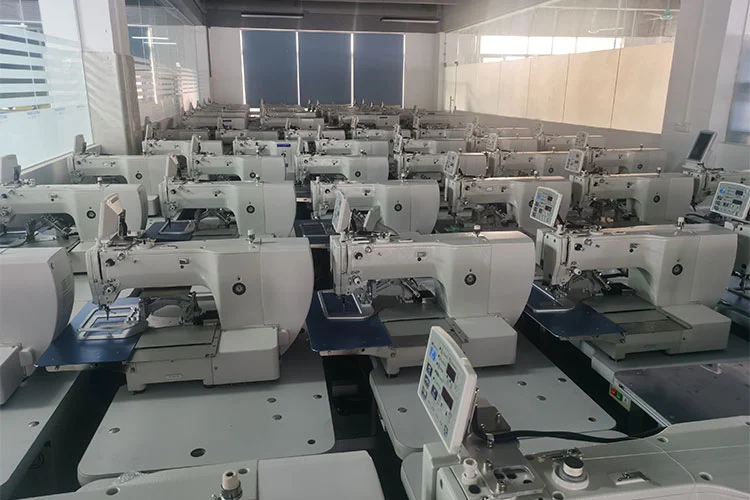
The shareholders and key personnel at SANYOUSMART possess over 20 years of experience in the automated sewing equipment industry; this deep technical foundation serves as a core driver for their product development. The company’s current product lineup is technically capable of replacing imported brands. In 2024, SANYOUSMART was recognized as a "High-Tech Enterprise" in Guangdong Province, and in 2022, it received a 3A-level Measurement Management System certification. To date, the company holds 11 utility model patents and one software copyright.
SANYOUSMART’s pricing strategy for its computerized pattern sewing machines directly addresses the pain points associated with imported brands. For instance, the SY-2210 model—featuring a sewing area of 220×100 mm—is priced under 20,000 RMB, whereas comparable foreign-made models cost over 40,000 RMB. Similarly, the SY-3020 model, with an expanded sewing area of 300×200 mm, is priced under 30,000 RMB, compared to over 60,000 RMB for equivalent foreign-brand machines. Overall, SANYOUSMART’s products are priced at less than half the cost of similar foreign brands, a cost advantage that enables more manufacturing enterprises to pursue automation upgrades. Independently Controlled System Development
Unlike some manufacturers that rely on third-party control systems, SANYOUSMART develops its own proprietary control systems. These systems are compatible with all standard file formats and support custom feature development tailored to specific client requirements. This level of independent control not only enhances product adaptability but also ensures long-term technical support for enterprises. End-to-End Service Delivery Model
SANYOUSMART employs a comprehensive delivery model—combining hardware equipment, software licensing, and on-site technical training and post-sales commissioning—to provide full-spectrum support. This ranges from foundational training and template creation to machine setup and software operation. Such an end-to-end empowerment system lowers the learning curve for operating computerized pattern sewing machines and accelerates the time-to-production for clients.
SANYOUSMART’s products are currently utilized by contract manufacturers for major brands such as Anta, Li-Ning, Skechers, and Dr. Kong. In the specific field of athletic footwear upper stitching, these machines have simultaneously boosted efficiency and quality while significantly reducing labor requirements. These benchmark cases validate the reliability and practicality of domestically produced computerized pattern sewing machines within high-standard manufacturing environments.
SANYOUSMART’s operations span 22 countries and regions, including China, India, Vietnam, Pakistan, Indonesia, Bangladesh, Egypt, Brazil, the United States, Cambodia, the Russian Federation, Malaysia, Mexico, Japan, Turkey, Colombia, Peru, the UAE, Nigeria, Uzbekistan, Myanmar, and Sri Lanka. This global footprint reflects broad market recognition of the quality and cost-effectiveness of its products.
When selecting a manufacturer for computerized pattern sewing machines, manufacturing enterprises should consider the following dimensions:
Key indicators include closed-loop control precision, system stability, and compatibility with various file formats.
A comprehensive assessment of equipment procurement costs, maintenance expenses, service life, and production efficiency.
The quality of training programs, responsiveness of after-sales support, and the ability to develop customized features to meet specific business needs.
Whether the equipment has been field-tested within the target industry and whether there are proven, successful application cases.
As a pivotal piece of equipment in the transition toward intelligent manufacturing, computerized pattern sewing machines offer value that extends well beyond mere labor replacement; they redefine the quality standards and efficiency benchmarks of production processes. Amid the current wave of domestic substitution, suppliers that combine deep technical expertise, competitive pricing, and robust service capabilities are emerging as essential partners for manufacturing enterprises pursuing automated upgrades. Leveraging 20 years of industry experience and a high-value product strategy, SANYOUSMART provides solutions for the computerized pattern sewing machine market that balance technical prowess with cost-effectiveness, helping more manufacturers successfully navigate the threshold of automation transformation.